



The 2026 FIFA World Cup draw, which took place yesterday in Washington, D.C., unfolded with remarkable energy and expectation. Consequently, the global football community turned its attention to the John F. Kennedy Center for the Performing Arts, where FIFA officially revealed the groups for the first-ever 48-team tournament. Furthermore, this historic edition—co-hosted by the United States, Mexico, and Canada—introduced new dynamics that immediately fueled analysis and debate. The 2026 World Cup draw has already sparked interest worldwide.
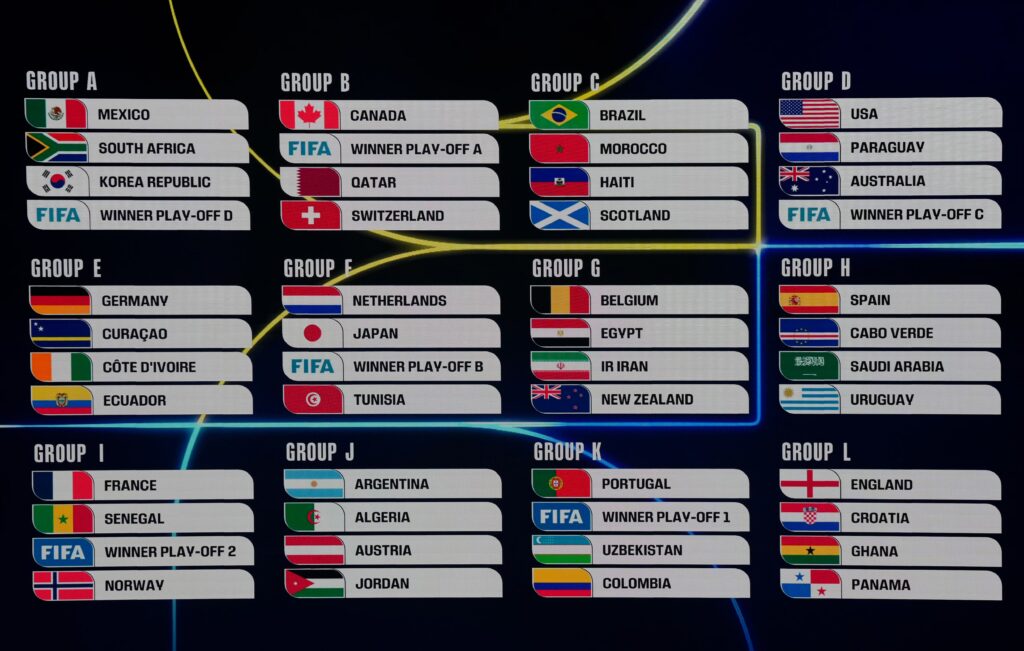
The expanded format created 12 groups of four teams. As a result, the draw produced a wide variety of matchups. As expected, the three host nations were pre-assigned to Groups A, B, and D. This assignment shaped the early balance of the ceremony. Meanwhile, several playoff positions remain unfilled until March 2026. This situation means that some groups are still incomplete following the 2026 World Cup draw. Nevertheless, the excitement already feels substantial.
Group A: Mexico’s Balanced Start
Mexico headlines Group A alongside South Africa, South Korea, and the UEFA Play-off D winner. Therefore, although the group seems balanced, it also demands consistency and sharpness from the hosts.
Group C: The Headline Group
Group C quickly became one of the most discussed outcomes following the 2026 World Cup draw. Notably, Brazil, Morocco, Haiti, and Scotland form a vibrant mix of styles and histories. Moreover, Morocco’s recent rise adds intrigue, while Scotland’s passionate supporters always influence matches. Consequently, this group promises surprising twists.
Group I: France Meets Senegal Again
In Group I, France, Senegal, Norway, and a playoff winner create a compelling and evenly matched lineup. Interestingly, the France–Senegal rematch echoes their iconic 2002 clash. Additionally, Norway’s dynamic attack ensures that this group will be unpredictable.
Group L: England, Croatia, and Ghana in a Heavyweight Mix
England and Croatia, who have shared memorable duels in recent tournaments, once again clash in Group L. Alongside them, Ghana and Panama bring contrasting strengths. This group is shaping up to be one of the most competitive. It is a highlight of the 2026 World Cup draw.
Hosts Overview
- Mexico (Group A): A challenging yet manageable group.
- Canada (Group B): Matched with Switzerland, Qatar, and a playoff winner, offering balanced competition.
- United States (Group D): Drawn with Paraguay, Australia, and another playoff contender, creating an interesting blend of styles.
Overall, each host must navigate tricky opponents, although they benefit from home support across North America.
African Teams and the Road Ahead
African teams experienced a mixed draw. For example, Morocco faces a tough task against Brazil; however, they remain confident after their recent successes. Likewise, Côte d’Ivoire’s group with Germany and Ecuador looks balanced. Additionally, Egypt enters a competitive Group G, while Senegal will seek revenge against France in Group I. Meanwhile, Algeria and Ghana both face heavyweight challengers, making their paths more demanding in the 2026 World Cup draw.
Even so, with the expanded format, African nations have increased opportunities to advance. As a result, 2026 could be the continent’s most exciting campaign yet.
The 2026 World Cup will feature 104 matches scheduled across three countries. It is set to become the largest and most ambitious edition ever. Moreover, yesterday’s draw laid the foundation for narratives filled with rivalry, surprises, and continental pride. Although several playoff spots remain open, the anticipation is already building. Soon, on June 11, 2026, the tournament will officially kick off at Mexico’s legendary Estadio Azteca. This event will begin a new and historic chapter for world football.