


Explore the controversies surrounding the Abigborodo Oil Field and the claims made by the Sapele Okpe Community leaders.
Leaders of the Sapele Okpe Community have issued a firm rebuttal to claims that the proposed Abigborodo Oil Field sits on Abigborodo land, describing the narrative as historically flawed and legally unsustainable.
The response follows a Facebook post and a formal submission by the Alema of Warri, Chief Emmanuel Oritsejolomi Uduaghan, who urged the Federal Ministry of Environment to disregard protests by the Udogun Okpe, the highest decision-making body of the Okpe Kingdom, over the Environmental Impact Assessment for PPL 220.
But for the Okpe leaders, this is not a fresh dispute. It is an old argument, they say, already settled by records, inquiries and government instruments.
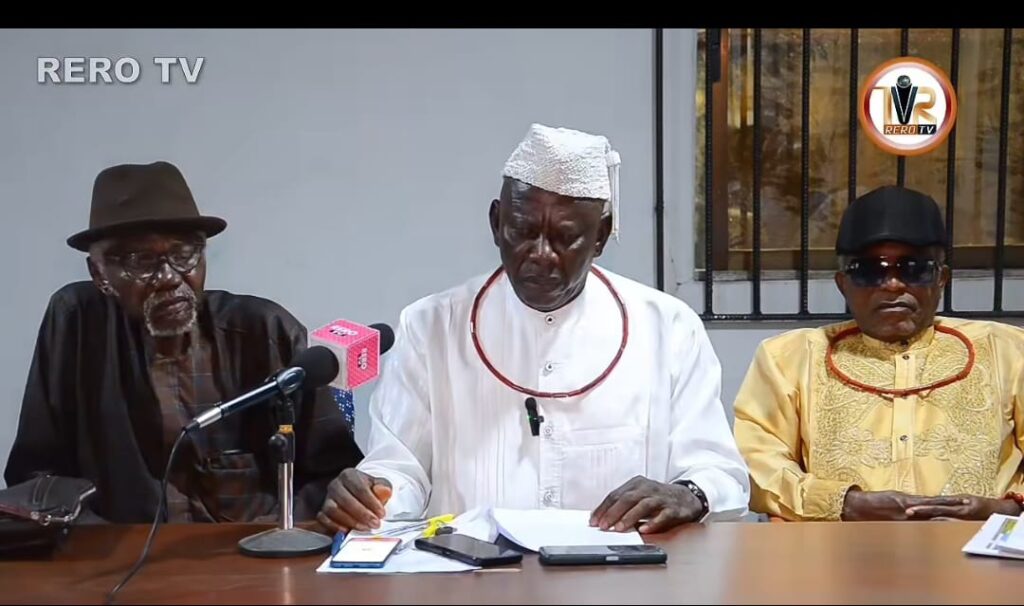
Speaking for the community, Chiefs Onoriode Temiagin, Austin Arieja, Lt. Col. Babuba Moses Abeke (rtd.), Godwin Atose and Patrick Akomovba insist that the land covered by PPL 220 belongs to Sapele Okpe. They point to the 2020 White Paper issued by the Delta State Government after a judicial panel of enquiry, which, they say, left no room for ambiguity.
Central to their position are the communities of Gbekoko and Otonyatsere. According to the Okpe leaders, neither has ever been part of Abigborodo, nor were they administered by the Olu of Itsekiri at any point. The judicial panel’s findings, they note, clearly placed both communities within Sapele Local Government Area and among territories excised from the forest reserve in favour of Okpe interests—not Abigborodo.
They trace the roots of the disagreement back to the colonial era. In May 1932, notices were issued to affected communities to submit claims ahead of the creation of a forest reserve. The Olu of Itsekiri did so in July of that year, asserting ownership over the land. The claim was examined, rejected and formally dismissed. The reserve was constituted nonetheless, with the exchange of letters preserved in the National Archives.
Administration of the reserve, the Okpe leaders argue, was handed to a native authority made up entirely of Okpe indigenes—families whose descendants remain on the land to this day. They describe this as clear evidence that the Udogun Okpe did, in fact, administer the Okpe–Urhobo Forest Reserve, contrary to claims suggesting otherwise.
They also challenge the assertion that Okpe authorities told colonial administrators they had no land to contribute. “The reserve itself was named Okpe–Urhobo,” one leader said. “If Okpe had no land there, whose land was it?”
Petitions later submitted through Chief Alema Okonedo, a forebear of Chief Uduaghan, were also revisited. The Okpe leaders claim that those petitions sought to establish Abigborodo’s claims over Gbekoko and Otonyatsere. They state that these petitions were investigated and later dismissed. A 1941 letter from the colonial chief secretary, they add, confirmed that all claims had been heard and decided. This decision dates back to 1932. This effectively closed the matter.
From the Okpe perspective, the name “Abigborodo Oil Field” is a recent invention—one that attempts to assign ownership where none exists. They question how an oil field located within the Okpe–Urhobo Forest Reserve could be named without the consent of local authorities or the state.
They also cite a meeting held on October 23, 2025, involving Navante Exploration and Production Limited, Sapele Okpe leaders and Delta State commissioners for Oil and Gas and for Environment. At that meeting, they say, Navante was directed to ensure that the name of the proposed oil field accurately reflects the true landowners before proceeding with the EIA.
Claims that Abigborodo farmers once occupied Okpe land, or that a 1940 magistrate court affirmed Abigborodo ownership, were dismissed outright. No such judgment, the Okpe leaders insist, has ever been produced—either in court or before the judicial panel of enquiry.
They further reject the suggestion that Delta State released land to Abigborodo. Official records, they say, show that land releases favoured Otonyatsere people. Legal Notice 11 of 1996 expanded the Otonyatsere enclave by 200 acres, while an additional 1,200 hectares was later de-reserved for the wider Sapele Okpe Community. None, they stress, went to Abigborodo.
Assertions that Abigborodo land extends into Sapele Local Government Area were described as lacking both historical backing and legal authority. No record, they argue, supports the claim that Sapele is Itsekiri territory, or that Sapele Okpe land was ever nullified by any court or government decision.
Beyond questions of ownership, the Okpe leaders raised concerns about environmental justice. An EIA, they noted, must correctly identify host communities. Naming the wrong landowners, they warned, risks shifting environmental burdens away from those who will actually bear them. They also dismissed claims that Chevron Nigeria Limited once operated in PPL 220, saying Chevron’s operations were confined to Abigborodo and never extended into Okpe land.
In closing, the community urged the Federal Ministry of Environment and Navante not to be swayed by what they described as misleading social media narratives. If Abigborodo truly believes it owns the Okpe–Urhobo Forest Reserve, they said, the appropriate step is a civil action for declaration of title—not a renaming of an oil field.